
WHY INDUSTRIAL VALVE BONNET SEALS FAIL?
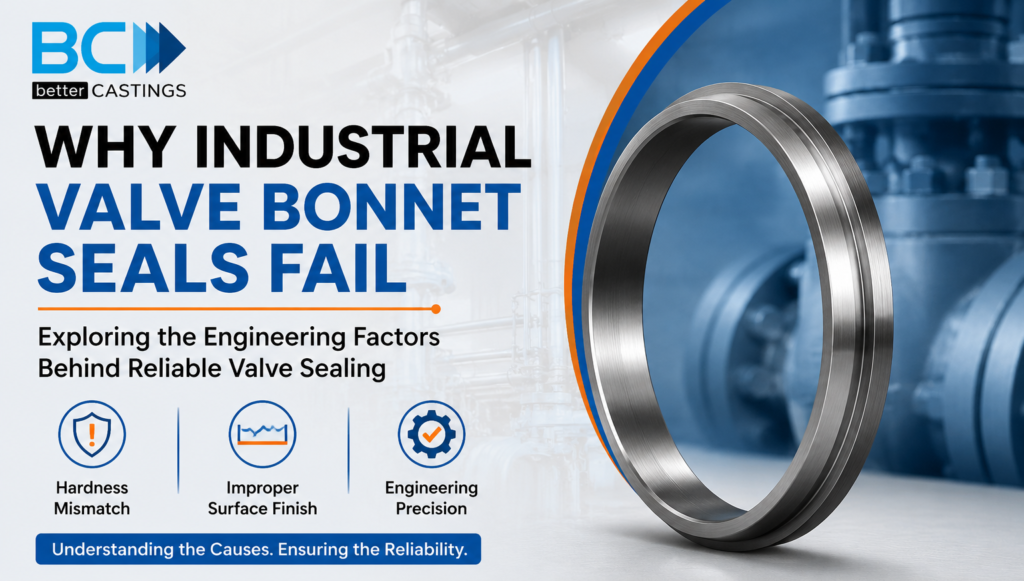
Bonnet seal failure is often caused by hardness mismatch, improper material selection, and incorrect surface finish specifications. When a seal is harder than the valve body, flange damage can occur, leading to persistent leakage and costly repairs. Surface roughness (Ra value) also affects sealing performance by influencing compression and wear. Understanding these factors is essential for maintaining valve reliability in refineries, power plants, and industrial systems. Proper seal specification is no longer optional—it is critical for preventing recurring failures and unplanned downtime.
WHAT IS AN INDUSTRIAL VALVE BONNET SEAL AND WHY IS IT IMPORTANT?
A valve bonnet seal is a precision-machined metal ring that locks the pressure boundary between the valve bonnet and the valve body. It keeps process media fully contained under demanding conditions. Across oil production, gas transmission, petrochemical refining, and high-pressure steam systems, even a small sealing failure causes production loss, regulatory penalties, and costly maintenance. Furthermore, bonnet seals must hold zero-leak performance through thermal cycling, pressure surges, and mechanical vibration.
In 2026, procurement engineers are moving away from generic seals toward components that are hardness-verified and surface-finish controlled. The bonnet seal is, therefore, no longer a commodity spare — it is an engineered solution that directly determines valve service life and operational safety.
WHY DO INDUSTRIAL VALVE BONNET SEALS FAIL?
Bonnet seal failure is rarely accidental — it is almost always the result of specification errors made before the seal enters service. However, understanding the root causes helps maintenance teams make smarter sourcing decisions and avoid repeat failures. The most common reasons why industrial valve bonnet seals fail include:
- Hardness mismatch between the seal and valve body causes irreversible flange scoring
- Incorrect Ra surface finish prevents microscopic peaks from compressing under load
- Generic seals that appear correct but lack proper material verification
- Missing traceability documentation makes root cause analysis impossible after failure
- Uneven bolt load creates localized stress that permanently compromises the sealing face
- Thermal cycling fatigue in high-temperature lines degrades seal contact over time
- Fugitive emission non-compliance accelerates seal degradation in refineries
In 2026, addressing these failure causes at the specification stage is the most cost-effective valve integrity strategy available.
CAN HARDNESS MISMATCH LEAD TO BONNET SEAL FAILURE?
Yes — and it is one of the most misdiagnosed problems in industrial valve maintenance today. When a bonnet seal carries a higher hardness rating than the valve body it contacts, the seal survives while the valve body does not. Every assembly cycle, the harder seal cuts into the softer flange face. As a result, microscopic scoring deepens with each retorque. By the time the damage becomes visible, the seating surface is already compromised. No replacement seal can form a reliable joint against a scored flange. This failure pattern is especially common in high-cycle valves in oil and gas pipelines and refinery process lines. Therefore, the fix is not a better seal — it is the correct seal, with hardness deliberately paired below the valve body specification from the start.
WHY SHOULD A BONNET SEAL BE SOFTER THAN THE VALVE BODY?
The hardness relationship between a bonnet seal and its mating valve body is the foundation of a reliable metal-to-metal seal. When both components share similar hardness or the seal exceeds the valve body rating, contact stress concentrates on the harder surface — and the softer one absorbs the damage. Since the valve body costs far more to replace than the seal, engineering demands the seal always sacrifices first.
A softer bonnet seal deforms slightly under compressive load, conforming to microscopic irregularities on the flange face and creating a pressure-tight joint. However, ignoring this hardness hierarchy means invisible flange scoring accumulates with every assembly cycle. In 2026 valve reliability standards, hardness pairing is treated as a primary selection criterion — not an afterthought — because protecting the valve body is always more cost-effective.
HOW DOES HARDNESS MISMATCH DAMAGE VALVE SEALING SURFACES?
- Hardness mismatch causes gradual damage to valve sealing surfaces and is often mistaken for a seal quality issue.
- When a bonnet seal is harder than the valve body, the compression load forces the softer valve flange to absorb most of the deformation stress.
- During each tightening and loosening cycle, the harder seal can create microscopic scratches and surface indentations on the flange.
- These small defects accumulate over time, becoming deeper and more severe with repeated maintenance activities.
- By the time the damage is visible, the valve flange surface may already be too compromised for a simple seal replacement to fix.
- For maintenance teams in refineries, LNG terminals, and process plants, this often results in recurring leaks that cannot be eliminated by re-tightening the joint.
- Using bonnet seals with verified Brinell or Rockwell hardness values that match the valve body material helps prevent sealing surface damage.
- Proper hardness matching protects flange integrity, extends valve service life, and supports fugitive emission compliance.
HOW CAN SURFACE FINISH CAUSE BONNET SEAL FAILURE?
• Surface finish is not a cosmetic spec — it is the core parameter that determines seal performance under live operating pressure
• The Ra value controls how microscopic peaks behave under bolt load — correctly specified, they compress to create a leak-tight joint
• An overly smooth surface leaves no material to deform — the two faces cannot achieve micro-level contact to hold pressure
• An excessively rough surface causes peak tearing instead of compression — destroying the seal zone before operating conditions begin
• Dimensional accuracy without surface finish control means nothing — a seal can pass every drawing check and still leak on first pressurization
• In 2026, surface finish verification is a mandatory inspection point across oil and gas, petrochemical, LNG, and power generation
• Fugitive emission compliance, plant reliability targets, and API valve standards all depend on OEM Ra-specified seals
• Sourcing seals without confirmed Ra documentation is a leading cause of repeat failures and rising valve maintenance costs
WHAT HAPPENS WHEN THE SURFACE FINISH IS TOO ROUGH?
When the surface finish of a bonnet seal is too rough, the microscopic peaks do not compress under load — they tear, fracture, and collapse. As a result, the contact zone is destroyed before a proper seal is ever formed. Additionally, torn surface peaks create micro-gaps that allow pressurized media to bypass the seal entirely. Irreversible flange damage occurs at first torque, meaning the valve body becomes compromised before operations even begin. Furthermore, fugitive emissions increase significantly, directly violating 2026 EPA and ISO 15848 emission compliance standards. Therefore, OEM Ra value verification during incoming inspection is the only reliable way to catch out-of-spec finish before installation. Facilities under API 598, ASME B16.34, and PED 2014/68/EU standards cannot afford surface finish non-conformance at any stage.
CAN AN OVERLY SMOOTH SURFACE CAUSE BONNET SEAL FAILURE?
An overly smooth bonnet seal surface is one of the most misunderstood failure triggers in industrial valve maintenance. It gets overlooked precisely because it looks flawless. However, metal-to-metal sealing depends on controlled micro-level contact — the sealing face needs a specific degree of texture to generate deformation under bolt load. When surface finishing goes beyond the acceptable Ra value range, that functional texture disappears completely.
As a result, the seal sits against the valve body without any material flow, no gap bridging occurs, and operating pressure finds its path through — producing a leak that no reassembly will permanently fix. Therefore, for valve engineers and procurement teams working on offshore platforms and crude refineries, an over-polished bonnet seal is a hidden liability. In 2026, surface finish must be verified against OEM specifications before every critical valve assembly.
HOW DO MANUFACTURERS PREVENT BONNET SEAL FAILURE?
Preventing bonnet seal failure starts long before the seal reaches the valve — it begins at the material selection stage. Moreover, leading manufacturers in 2026 follow a rigorous process to ensure every seal performs under real operating conditions:
- Hardness is paired precisely to the valve body spec — the seal always yields before the mating surface does
- Surface finish is machined and verified to the exact OEM Ra value — so microscopic peaks compress correctly under load
- Material composition is tested and certified before machining begins — eliminating substandard alloys
- Dimensional inspection is performed on every seal against original valve drawings, not generic tolerances
- Full material traceability is maintained from raw casting to finished component for audit compliance
- OEM valve specifications are referenced for every order — ensuring seals are engineered to the valve, not a generic catalog
Therefore, sourcing from manufacturers who follow this process is the most reliable way to eliminate repeat failures and reduce unplanned valve downtime in 2026.
WHAT BEST PRACTICES IMPROVE LONG-TERM BONNET SEAL RELIABILITY?
- Long-term bonnet seal reliability starts with one decision — sourcing seals that are engineered specifically to your valve body, not selected from a generic catalog.
- Hardness pairing is the first non-negotiable practice — every bonnet seal must be softer than the valve body it contacts, so the seal absorbs compressive stress instead of damaging the flange face.
- Surface finish must be verified against OEM Ra values before installation — neither over-polished nor excessively rough surfaces can deliver consistent metal-to-metal sealing performance in critical process lines.
- Pre-installation dimensional inspection against original valve drawings eliminates fitment risk before the valve ever reaches operating pressure.
- Bolting discipline matters equally — cross-pattern torque sequences distribute seating load evenly, preventing localized stress that silently compromises the sealing face over time.
- In 2026, condition-based replacement scheduling is replacing fixed-interval maintenance across oil and gas pipelines, LNG terminals, petrochemical refineries, and power generation assets — reducing unnecessary downtime and part wastage significantly.
- Material traceability and alloy certification at every stage of the supply chain are now mandatory requirements under API 598, ASME B16.34, and global fugitive emission compliance frameworks.
- Valve maintenance teams and procurement engineers who embed these practices consistently report fewer seal failures, stronger emission audit outcomes, and measurable improvement in overall valve service life.
FAQ's
What is the main reason industrial valve bonnet seals fail?
Hardness mismatch between the seal and valve body is the primary cause — the harder seal scores and damages the flange face with every assembly cycle. Incorrect Ra surface finish is the second leading cause of bonnet seal failure.
How does hardness mismatch cause bonnet seal failure?
When a bonnet seal is harder than the valve body, every torque cycle embeds microscopic scratches into the softer flange face. Over time, the seating surface becomes permanently compromised.
What Ra surface finish value is required for metal-to-metal bonnet seals?
The correct Ra value must match the OEM valve specification — too smooth leaves nothing to deform, too rough causes surface peaks to tear instead of compress.
Can a dimensionally correct bonnet seal still leak?
Yes — a seal can pass every dimensional check and still leak on first pressurization. Surface finish and hardness pairing are equally critical to sealing performance.
How often should industrial valve bonnet seals be replaced?
In 2026, condition-based replacement is replacing fixed-interval schedules across oil and gas and petrochemical facilities. Replacement should be triggered by inspection findings, not calendar intervals.
What industries are most affected by bonnet seal failure?
Oil and gas, petrochemical refining, LNG processing, and power generation are most impacted. Even a single seal failure in these sectors can trigger unplanned shutdowns and emission violations.
How does bonnet seal failure affect fugitive emission compliance?
A failed bonnet seal creates micro-gaps across the sealing face, allowing process media to escape and directly violating API 641 and ISO 15848 emission standards.
How do I choose the right bonnet seal for my valve?
Match hardness grade, OEM Ra surface finish, and verified material composition to your specific valve body. Dimensional inspection against original valve drawings is mandatory before installation.
What standards govern industrial valve bonnet seal performance?
API 598, ASME B16.34, API 641, ISO 15848, and PED 2014/68/EU are the key governing standards in 2026. Full material traceability and dimensional certification are mandatory for critical process applications.
Where can I source reliable industrial valve bonnet seals in India?
Better Castings supplies hardness-matched, OEM Ra-verified, and fully traceable bonnet seals engineered to your exact valve specification. Refineries, LNG plants, and power generation facilities across India rely on Better Castings for zero-failure seal performance.
